
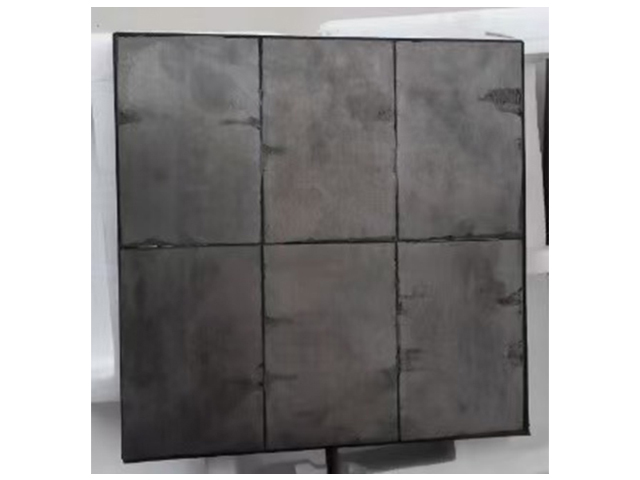

Description
In comparison to other ceramics, RBSC maintains its mechanical strength and structural integrity at elevated temperatures, typically up to 1,350°C. It also has a relatively low thermal expansion, contributing to its dimensional stability under thermal cycling conditions. Despite being very hard and brittle like other ceramics, the infiltration process gives RBSC a certain toughness advantage. Its ability to be manufactured into thin-walled or complex parts without post-sintering machining helps reduce production costs and makes it an attractive option for engineers and designers seeking durable, high-performance ceramic solutions.
| PHYSICAL PROPERTY | UNITS | TYPICAL VALUE |
|---|---|---|
| Microstructure | % | 87% SiC, 12% Si |
| Density | g/cc | > 3.02 |
| Open Porosity | % | < 0.1 |
| Max Use Temperature | °C | 1380 |
| Flexural Strength | MPa | 250 @ 20°C 280 @ 1200°C |
| Compressive Strength | MPa | 2500 |
| Modulus of Elasticity | GPa | 330 @ 20°C 300 @ 1200°C |
| Coefficient of Thermal Expansion (20–1000°C) |
1 × 10⁻⁶/°C | 4.5 |
| Thermal Conductivity @ 1200°C | W/mK | 45 |
| Poisson’s Ratio | – | 0.2 |
| Vickers Hardness | GPa | 20–22 |
| Acid & Alkali Corrosion Resistance | – | Excellent |
All properties are at room temperature (20°C) unless otherwise stated.


